Dhaka 6:13 pm, Saturday, 15 August 2026
Bangla

Syndicate Exposed: How Extortion and Fictitious Jobs Plunge Bangladeshi Migrants into Crisis

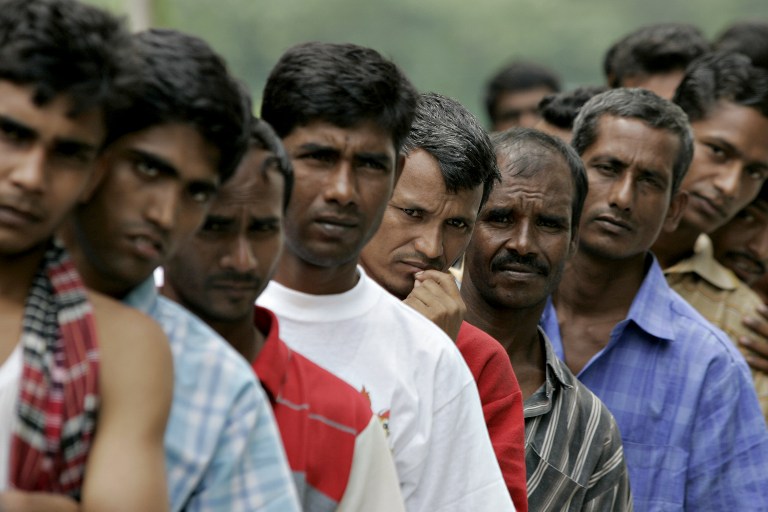
TO GO WITH Finance-economy-SAsia-remittances,FOCUS by Shafiq Alam (FILES) This file photo taken on December 25, 2007 shows Bangladeshi migrant workers waiting in line for food donated by a goodwill charity group for Christmas outside the Bangladeshi High Commission in Kuala Lumpur. The global economic crisis is putting a dent in funds sent to poor South Asian countries by nationals working abroad amid fears their armies of cheap workers will become redundant, say recruitment agents. Millions of families in Bangladesh, Nepal and Sri Lanka rely on remittances from relatives working in construction or as domestic servants in booming southeast Asian and Gulf nations. AFP PHOTO / FILES / TENGKU BAHAR

For 34-year-old Mofizul Islam, a father from Narsingdi, selling his last remaining ancestral farmland was meant to be an investment in his family’s future. To secure a job in Malaysia, he managed to raise nearly Tk 600,000.

Instead of finding stability, Mofizul became trapped in deep financial distress. Although the government-fixed migration cost for Malaysia stands at Tk 79,000, he was allegedly forced to pay nearly seven times that amount to a powerful recruitment syndicate. Upon arriving in Kuala Lumpur, he discovered no employer waiting for him, holding instead an offer letter allegedly issued by a fictitious company. Left without work, he spent months surviving in precarious conditions.

Mofizul’s ordeal is not an isolated incident. Thousands of Bangladeshi migrant workers continue to fall victim to irregular migration practices driven by entrenched syndicates within the Malaysia migration corridor—widely recognized as one of the most expensive and corrupt in the world.

The current crisis stems from developments following July 2022, when Malaysia reopened its labor market after a nearly four-year suspension. The Malaysian government requested a list of licensed recruiting agencies from Bangladesh to handle worker deployment.

While the Ministry of Expatriates’ Welfare and Overseas Employment initially submitted a pool of 1,520 licensed agencies, only a select group was ultimately granted authorization. Beginning with an exclusive group of 25 agencies, the circle gradually expanded to over 100 across three phases.

Investigations and legal filings reveal that these agencies allegedly formed a tight-knit syndicate to control market access and extract exorbitant fees from hopeful workers.

In 2024, Altaf Khan, a licensed recruiting agency owner based in Malaysia, filed a lawsuit against 103 agencies implicated in running the network from Bangladesh.

“Bangladesh has more than 2,000 licensed recruiting agencies, but the accused operate as an organized human trafficking network,” Altaf Khan told Deshkal News. “Even when we, as legitimate license holders, secured overseas job demand letters under our own agency names, we were forced to pay ransom amounts ranging from Tk 100,000 to Tk 106,000 per worker to them… Without making these payments, we were unable to send workers abroad.”

According to Khan, the syndicate members established a local entity named Bennnet Bangladesh Limited—which he describes as a domestic extension of the Malaysian software company Bestinet Sdn Bhd. The network allegedly utilized Bestinet’s Foreign Workers Central Management System (FWCMS) platform to tightly control operations and lock out non-compliant agencies.

Mounting pressure and regulatory reviews have recently led the government to revoke the licenses of 49 recruiting agencies. Significantly, several of these canceled firms are linked to prominent political figures from the previous administration:

Orbitals Enterprises & Orbital International: Owned by the wife and daughter of former Finance Minister A.H. Mustafa Kamal. Ahmed International: Owned by former Dhaka-20 MP Benazir Ahmed. Snigdha Overseas Limited: Owned by former Feni-2 MP Nizam Uddin Hazari. Five M International: Owned by former Feni-3 MP Lt. Gen. (Retd.) Masud Uddin Chowdhury.

Furthermore, case files obtained by this correspondent name former Expatriates’ Welfare and Overseas Employment Minister Imran Ahmed and former Senior Secretary Dr. Ahmed Munirus Salehin, alleging their complicity in mass financial exploitation. Other prominent figures listed include Noor Ali of Unique Eastern Private Limited and Ruhul Amin alias Swapan of Catharsis International, identified as key operators within the Malaysia syndicate.

A ministry official noted that while licenses can be issued decades in advance, violations of licensing terms, serious criminal offenses, or threats to national security serve as legal grounds for immediate revocation.

In response to the scandal, State Minister for Expatriates’ Welfare and Overseas Employment Nurul Haque issued a stern warning to fraudulent agencies, urging them to halt unauthorized recruitment activities immediately.

“Those involved in fraudulent activities should change their ways. Law enforcement agencies, including the Detective Branch (DB), are monitoring everyone. If you do not stop now, you will face the consequences,” Nurul Haque stated.

Similarly, Prime Minister’s Adviser and Spokesperson Mahdi Amin advised aspiring migrant workers on July 30 to exercise patience, adhere strictly to official channels, and avoid reliance on middlemen and unauthorized syndicates.

Industry experts, however, remain cautious. Andy Hall, an independent migrant worker rights specialist, warned that the syndicate could resurface as talks to reopen the Malaysian labor market progress.

Meanwhile, Ali Haider Chowdhury, former Secretary General of BAIRA and Director of the East West Human Resource Center Ltd., emphasized the urgent need for structural reform, asserting that migration costs must be minimized and the physical and financial safety of outbound workers must be aggressively safeguarded by the state.
Tag :

Syndicate Exposed: How Extortion and Fictitious Jobs Plunge Bangladeshi Migrants into Crisis

Update Time : 09:28:38 am, Friday, 7 August 2026

For 34-year-old Mofizul Islam, a father from Narsingdi, selling his last remaining ancestral farmland was meant to be an investment in his family’s future. To secure a job in Malaysia, he managed to raise nearly Tk 600,000.

Instead of finding stability, Mofizul became trapped in deep financial distress. Although the government-fixed migration cost for Malaysia stands at Tk 79,000, he was allegedly forced to pay nearly seven times that amount to a powerful recruitment syndicate. Upon arriving in Kuala Lumpur, he discovered no employer waiting for him, holding instead an offer letter allegedly issued by a fictitious company. Left without work, he spent months surviving in precarious conditions.

Mofizul’s ordeal is not an isolated incident. Thousands of Bangladeshi migrant workers continue to fall victim to irregular migration practices driven by entrenched syndicates within the Malaysia migration corridor—widely recognized as one of the most expensive and corrupt in the world.

The current crisis stems from developments following July 2022, when Malaysia reopened its labor market after a nearly four-year suspension. The Malaysian government requested a list of licensed recruiting agencies from Bangladesh to handle worker deployment.

While the Ministry of Expatriates’ Welfare and Overseas Employment initially submitted a pool of 1,520 licensed agencies, only a select group was ultimately granted authorization. Beginning with an exclusive group of 25 agencies, the circle gradually expanded to over 100 across three phases.

Investigations and legal filings reveal that these agencies allegedly formed a tight-knit syndicate to control market access and extract exorbitant fees from hopeful workers.

In 2024, Altaf Khan, a licensed recruiting agency owner based in Malaysia, filed a lawsuit against 103 agencies implicated in running the network from Bangladesh.

“Bangladesh has more than 2,000 licensed recruiting agencies, but the accused operate as an organized human trafficking network,” Altaf Khan told Deshkal News. “Even when we, as legitimate license holders, secured overseas job demand letters under our own agency names, we were forced to pay ransom amounts ranging from Tk 100,000 to Tk 106,000 per worker to them… Without making these payments, we were unable to send workers abroad.”

According to Khan, the syndicate members established a local entity named Bennnet Bangladesh Limited—which he describes as a domestic extension of the Malaysian software company Bestinet Sdn Bhd. The network allegedly utilized Bestinet’s Foreign Workers Central Management System (FWCMS) platform to tightly control operations and lock out non-compliant agencies.

Mounting pressure and regulatory reviews have recently led the government to revoke the licenses of 49 recruiting agencies. Significantly, several of these canceled firms are linked to prominent political figures from the previous administration:

Orbitals Enterprises & Orbital International: Owned by the wife and daughter of former Finance Minister A.H. Mustafa Kamal. Ahmed International: Owned by former Dhaka-20 MP Benazir Ahmed. Snigdha Overseas Limited: Owned by former Feni-2 MP Nizam Uddin Hazari. Five M International: Owned by former Feni-3 MP Lt. Gen. (Retd.) Masud Uddin Chowdhury.

Furthermore, case files obtained by this correspondent name former Expatriates’ Welfare and Overseas Employment Minister Imran Ahmed and former Senior Secretary Dr. Ahmed Munirus Salehin, alleging their complicity in mass financial exploitation. Other prominent figures listed include Noor Ali of Unique Eastern Private Limited and Ruhul Amin alias Swapan of Catharsis International, identified as key operators within the Malaysia syndicate.

A ministry official noted that while licenses can be issued decades in advance, violations of licensing terms, serious criminal offenses, or threats to national security serve as legal grounds for immediate revocation.

In response to the scandal, State Minister for Expatriates’ Welfare and Overseas Employment Nurul Haque issued a stern warning to fraudulent agencies, urging them to halt unauthorized recruitment activities immediately.

“Those involved in fraudulent activities should change their ways. Law enforcement agencies, including the Detective Branch (DB), are monitoring everyone. If you do not stop now, you will face the consequences,” Nurul Haque stated.

Similarly, Prime Minister’s Adviser and Spokesperson Mahdi Amin advised aspiring migrant workers on July 30 to exercise patience, adhere strictly to official channels, and avoid reliance on middlemen and unauthorized syndicates.

Industry experts, however, remain cautious. Andy Hall, an independent migrant worker rights specialist, warned that the syndicate could resurface as talks to reopen the Malaysian labor market progress.

Meanwhile, Ali Haider Chowdhury, former Secretary General of BAIRA and Director of the East West Human Resource Center Ltd., emphasized the urgent need for structural reform, asserting that migration costs must be minimized and the physical and financial safety of outbound workers must be aggressively safeguarded by the state.